
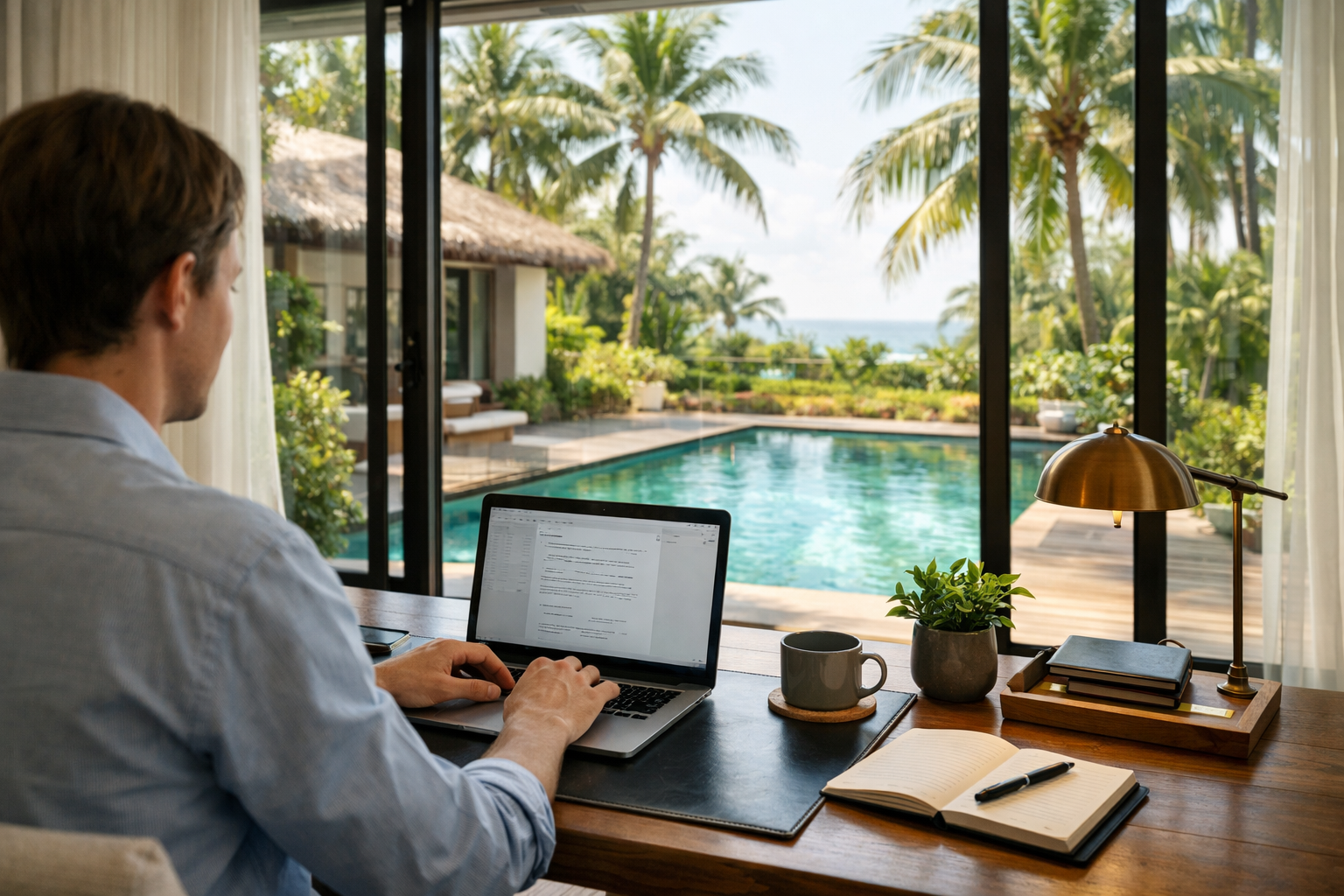
The idea that you could run a serious career from a villa in Bali or a farmhouse in Tuscany used to be a fantasy reserved for a handful of freelancers and tech entrepreneurs. That's no longer the case. The normalisation of remote work across entire industries has created a new class of property buyer — one whose location is a choice, not a constraint.
From Holiday Home to Primary Residence
The traditional model for international property was the holiday home: a place you visited for two or three weeks a year and rented out the rest of the time. Remote work has collapsed that model. Buyers are now looking for properties they can live in for three to six months at a stretch, with reliable internet, proper workspaces, and the kind of daily infrastructure — supermarkets, gyms, healthcare — that supports real life rather than just vacation.
The Connectivity Premium
Fibre internet access has become a genuine differentiator in property markets that previously didn't need it. In Bali, villas with dedicated fibre connections command measurably higher rental rates than equivalent properties relying on mobile data. The same pattern is visible in Portugal's Algarve, Mexico's Riviera Maya, and Thailand's islands. A property without reliable high-speed internet is effectively excluded from the fastest-growing segment of the rental market.
Co-Living and Co-Working Adjacency
Smart developers in remote-work hotspots are building properties adjacent to co-working spaces, or integrating shared workspace into villa compounds. This hybrid model recognises that remote workers want both the privacy of a villa and the social infrastructure of an office. Properties within walking distance of established co-working hubs consistently outperform isolated alternatives on occupancy rates.
Tax and Visa Implications
The legal framework hasn't caught up with the lifestyle. Digital nomad visas exist in around 50 countries now, but tax residency rules remain complex. Buyers need to understand that living in a property for extended periods can trigger local tax obligations that pure vacation use wouldn't. This isn't a reason to avoid the market — it's a reason to get proper advice before committing.
Investment Implications
For property investors, the remote work shift means rethinking what makes a villa rentable. A dedicated office space, ergonomic desk setup, and fast internet are now as important as pool size and bedroom count. Properties that cater to the working visitor — with quiet zones, good lighting, and practical kitchens — are seeing booking durations extend from one week to one month or longer, which dramatically improves yield efficiency.